
Which client did your AI bill work for?
TraceROI allocates your Claude Code, Cursor, Copilot and OpenAI spend to clients, projects and teams, and ties every total back to the vendor invoices. Bill it through, or know your real margin on every account.
Not an agency? See TraceROI for product teams →
Read-only by design
Narrowest vendor scopes. We never write to your systems.
Metadata, never code
Costs, repo names, timestamps, commit counts. No code, prompts or client content.
A method you can audit
Every line says how it was placed: exact, mapped key, activity split or unallocated.
Honest about limits
Hosted in the US. No SOC 2 yet. Unplaced spend is shown, never spread silently.
AI is now a cost of delivering every project. Nobody can say which one.
Your team runs Claude Code, Cursor and Copilot across every client. The invoices arrive per tool and per seat. Your client invoices go out per project.
So the AI cost either gets absorbed into margin, or guessed onto a client. Neither survives a fixed-bid project or a client who asks.
The vendors bill per person. You bill per client.
Every vendor dashboard shows spend by user, for its own tool. None of them knows what a client is. So the allocation happens in a spreadsheet, if at all.
Today
- Four invoices, four dashboards, one "AI tools" line in the books
- People work across clients, so per-user spend doesn't map to accounts
- Fixed-bid margins quietly absorb agent runs
- Pass-through charges are rough estimates a client can challenge
- Idle seats renew every month
With TraceROI
- One ledger for every AI tool, reconciled to each vendor invoice
- Spend placed on the client and project by the repo it ran in
- A monthly statement per client, with the method on every line
- Real AI cost and margin per account, or per team and cost centre
- Paid vs active seats on every tool
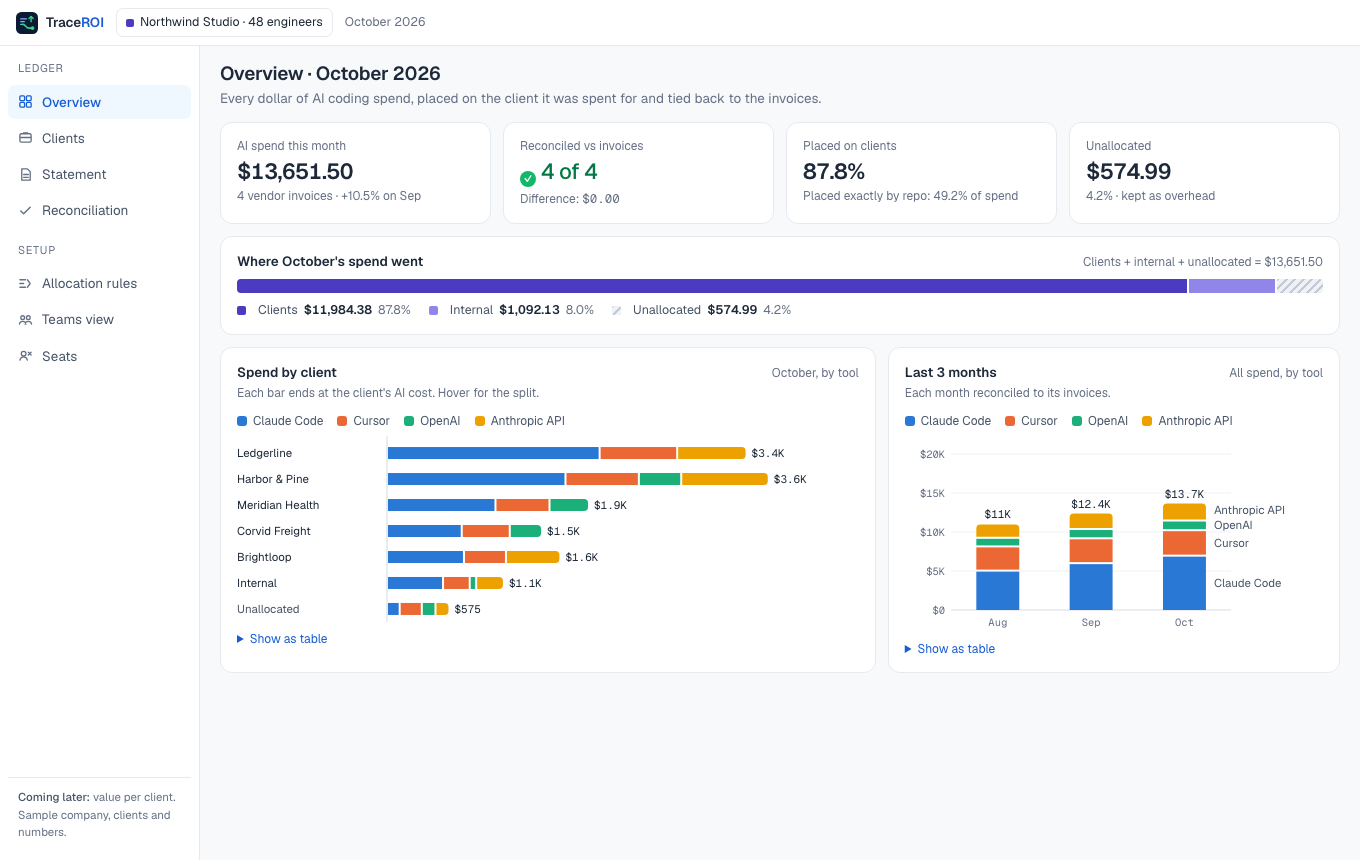
Pick a line on the invoice. See which client it belongs to.
Every dollar is placed by the most exact evidence available, and every placement says which method it used.
Illustrative data for a fictional 48-engineer studio.
Map your repos once. Get a statement per client every month.
Connect, read-only
Claude Code telemetry (rolled out by your admin), Anthropic and Cursor admin keys, and a read-only GitHub app. OpenAI and Copilot follow.
one setup callMap repos to clients
Each repo, GitHub org, API key or workspace is assigned to a client and project, or to a team. Bulk rules by naming pattern.
onceReconcile and bill
Each month the ledger ties to every vendor invoice, then produces a statement per client (PDF and CSV) and a margin view.
every monthSix questions you can answer at month-end.
By client and project, across every tool, tied to the invoices.
A statement per client, with your markup rule applied per account.
AI cost next to each client, so fixed-bid surprises show up early.
The share placed by telemetry or a mapped key, vs split by activity.
Unallocated spend, shown on its own line, handled by the rule you choose.
Paid vs active seats on every tool, with monthly savings in your currency.
How much AI spend can't you put on a client today?
Move the sliders to match your firm. The percentages are your assumptions; TraceROI replaces them with real numbers.
Of which $0 pays for seats nobody really uses, and $0 sits on no client's account: absorbed into your margin.
Estimates from your inputs, not a promise.
Good tools exist. None of them knows what a client is.
| What it does well | What it doesn't give a services firm | |
|---|---|---|
| Vendor dashboards Anthropic, Cursor, GitHub, OpenAI | Free. Usage and spend per user for that vendor's tool. | One tool each. No client or project view. |
| Spend management e.g. Ramp | Spend by user, model and team across vendors, with controls. | No allocation to clients or projects in public materials. |
| Engineering analytics e.g. Swarmia, Zest, Faros | Cost per PR or team, and delivery metrics for product engineering. | Built around internal teams and initiatives. No client statement. |
| Time tracking / agency tools | Hours and expenses per client. | AI spend arrives as a hand-entered lump sum. |
| LLM gateways | Per-key metering and budgets for API traffic. | Traffic must go through a proxy; seat-based tools aren't covered. |
| TraceROI (early access) | AI spend per client, project or team across tools, reconciled to invoices, as a statement you can bill from. | New and small. No SOC 2 yet. Claude Code is the most exact source; other tools are allocated by repo activity. |
Based on public product materials as of November 2026. Tell us if something here is out of date.
What people ask first.
Is it available now?
Not yet. TraceROI is in private build. Early access opens in the new year, starting with a small group of firms. Join the list and we'll tell you when it opens.
How do you know which client a session was for?
Most exactly from Claude Code's telemetry, which records the repository each session ran in. API keys and workspaces you assign to a client are placed by that mapping. Tools without a repo field (Cursor, Copilot) are split by each person's commit and PR activity per repo that day. Whatever can't be placed stays unallocated, on its own line.
Will the totals match our invoices?
Yes, by design. Allocated plus unallocated always equals each vendor invoice. Seat-plan estimates are scaled to the invoice, and splits use exact integer cents, so nothing is rounded away.
Do you read our code or our clients' content?
No. We store metadata only: costs, repo names, timestamps and commit counts. No code, diffs, prompts or AI outputs. See Security.
We're a product company, not an agency.
The same ledger works with teams and cost centres instead of clients. See TraceROI for product teams.
What about ROI?
We start with what can be measured exactly: where the money went. Value and ROI per client or feature come later, on top of a ledger you already trust.
Be first to put your AI bill on the right accounts.
TraceROI is in private build. Join the early-access list and we'll invite a small group of firms first, in the new year. No spam, and no sales calls before then.
Got 2 minutes? Tell us how you handle AI cost with clients →
Thank you. You're on the list. We'll email you when early access opens.